Home > The President's Office > In the News > News Archive > Goucher Gazette Interview

Goucher Gazette Interview

Introducing Sandy Ungar, Tenth President of Goucher College

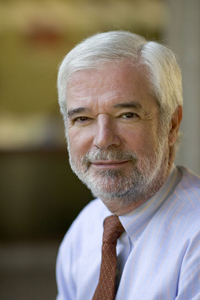
Following a months-long search process that had, by its end, engaged most of the members of the campus community, the Goucher College Board of Trustees announced on March 17 its selection of Sanford (Sandy) Ungar as the tenth president of the college. Ungar succeeds Dr. Judy Jolley Mohraz, who left the college last August to head the Virginia G. Piper Charitable Trust.

Since 1999, Ungar has served as the director of Voice of America, supervising an 1,150-employee international broadcasting organization, providing news, information, and music programming in 53 languages via short-wave, medium-wave, and FM radio. From 1986 to 1999, he was dean of the School of Communication at American University in Washington, DC, guiding the school through its transition as it split from the College of Arts and Sciences and became an independent school with a liberal arts focus.

Ungar is also a well-known print and broadcast journalist, contributing over the course of his long and varied career to The Washington Post, The Economist, The Atlantic, and United Press International. He has hosted All Things Considered and other programs on National Public Radio, and he has written or edited six books on topics ranging from Africa to the FBI to an overview of American foreign policy.

Ungar comes to Goucher with a stunning range of experience, and from all appearances seems to be positively brimming with energy, enthusiasm, and ideas about what he would like to see happen at the college. Here, in his first interview with the Goucher Gazette, he talks about the search process, his impressions of the college, and the future, both near and distant, of Goucher College.

How did you become involved in the presidential search to begin with?

Well, chance favors the prepared mind, I suppose. This is something I've been wanting to do. When I talked with friends about life and goals and that sort of thing, what I said was that I'd like to be president of a liberal arts college. But I never would have believed that it would not only happen so quickly, but also be so exactly what I was looking for. I know I must sound like a Pollyanna, but it's true. I couldn't have designed a better opportunity for myself. Goucher has had such good leadership, and there are so many enthusiastic, committed people at the college -- it's a wonderful situation to come into.

What interested you about Goucher at first?

The sense that the college is still in the process of defining itself - that and its desire to become more of a player on the national higher-education scene and more international in the scope of the education it offers. Baltimore, as a traditional port city, trade center, and intellectual center, is the ideal place for all of that to happen, and Goucher has such good building blocks in place already on which to grow further.

Had you been familiar with Goucher before you were nominated as a candidate?

I had never visited before, but I knew a number of Goucher alums, and I knew from them how effectively the college had prepared people so well for so many different kinds of interesting lives.

What kind of impression of the campus community did you get visiting for the first time?

Well, the first time I actually visited was in the middle of a horrible storm, so there were about six people actually walking around the campus. I met with the search committee, who gave me a lot of materials and publications about Goucher. That was really my first impression, and I was struck by how open Goucher is about itself. It takes a lot of confidence to be that way. It seemed to me, from the publications I saw, that it had begun to take chances with its appearance. I liked that. I think it shows a willingness to try new things and think in new directions.

The position description itself was one of the longest I've ever read. That was great too -- it told me a lot about the strategic thinking that had already been done and the questions still being discussed, and they were issues I found appealing.

When I finally came for my campus visit, it was positively electrifying. I felt so welcome, and I was impressed with so many different aspects of the community. The faculty was interested in ideas over procedures, and eager to talk about the issues that are so important to liberal arts colleges right now. They're obviously people who are genuinely happy to be a part of Goucher. The students were delightful. There really didn't seem to be any kind of "Goucher stereotype." The stereotype is the individual - not any one kind of person or attitude or way of presenting oneself. And the staff was a very welcoming, good-humored group of people that I really felt I could fit into. I came away thinking there's a tremendous number of people here from whom I can learn.

You have a rather extraordinary range of experience in a lot of different areas of interest. In a broad sense, how do you feel that range will serve you in your new role as college president?

First of all, my experience as a journalist of all different shapes and sizes is, to me, the ultimate living-out of the liberal arts education and life. I've also spent 13 years as dean of a school that, like the various departments at Goucher, had a specific focus that it grounded in a strong liberal arts core. I was the host of All Things Considered as the show was reaching out, trying to expand its audience, and addressing a number of issues that were very important to the country. And most recently, I've been the director of Voice of America, which broadcasts in 53 languages and represents over 80 cultures within its organization.

Goucher, like all of the organizations and institutions I've worked with, is a place that brings all different kinds of people, experiences, perspectives, and ideas together in such a way that the whole is greater than the sum of its parts. I hope to be in a position to help that happen. I consider myself a public intellectual in a community of people who think that way.

What similarities do you see between the challenges you faced at American University and those you anticipate addressing at Goucher?

The School of Communication at AU was an excellent school, but not a lot people knew about it. There was a lot of building that needed to take place as far as its profile went. It also needed more diversity in a lot of different ways. Those are two similarities. And the curriculum at any school should always be under review for ways to improve it.

One of the biggest things was that, at AU, we really needed to find a way to bring the world into the school. We had excellent resources there, but we could also learn from bringing outsiders in to offer fresh perspectives, insights, and expertise. The attention we got from doing so was a collateral benefit. We were just showing people what we were doing there at the school and then taking the extra step of inviting them to be a part of that.

That's something I want to do at Goucher. I want to talk within the community and find out what ideas and interests are already there -- and then reach out. I want to start having events and meetings where we discuss these things publicly. I want to make a few splashes.

I know this is already going on there. The last thing I want to do is to come across as though I'm riding in with these great ideas to save the day. I can bring some fresh perspectives, certainly, but really what I want to do is bring attention to what's great about Goucher already.

How do you hope to bring your personal interest and experience in areas of international concern to bear on Goucher's interest in expanding its scope with regard to international education?

Voice of America is one of the most multicultural organizations in the world, and I've learned a lot there about the ways different cultures address various issues. One of the things that I've really come to appreciate from that is just how much of a decline there has been in American culture in thinking about things from an international perspective. If colleges don't lead the way in changing that, who will?

I think Goucher can and should help lead the way. We need to discover the international aspects of all of the issues we deal with. Growing up in the United States, there's a great temptation to believe in all the rhetoric and the idea that we have all the answers. But there are Asian and African cultures that have some great ideas about things like housing, transportation, relations with older people -- really making them feel like they're a part of the culture. Even in Europe -- Berlin is one of the most exciting cities in the world right now. The point is that there are lots of great ideas out there, and lots of people who do certain things better than we do, and we need to begin acknowedging that.

What other big-picture kinds of issues do you see yourself -- and Goucher -- addressing at this particular point in time and in its own history?

One is definitely fulfilling the promise of coeducation. Then there are issues of attrition and retention. We need to make the educational experience here as fulfilling as possible for as many as possible. There are the ongoing concerns -- meeting the college's financial needs and maintaining the physical plant -- and the curriculum has to be re-evaluated all the time.

Most of all, Goucher needs to make sure, like other liberal arts institutions, that it stays true to its mission of preparing people for all aspects of life as writers, as listeners, as thinkers in pursuit of lifelong learning and constantly expanding horizons. There is always room to grow and think outside your job or any other of the more narrow ways in which we define ourselves. Liberal arts institutions are in a uniquely great position to prepare people for exciting, fulfilling lives in which they never lose sight of that.

What will you be doing over the coming months to prepare for your arrival?

I'm going to be meeting with many more people, having some intensive discussions about what's going on now and what needs to be done. I'm going to drop by a few times this spring, not so much to speak as to listen. One of those times is going to be during the newly admitted freshmen's visits so I can share my excitement about coming to Goucher. It will be contagious, I'm sure. I'm also doing a lot of reading, steeping myself in Goucher, higher education, and liberal arts issues. I'll be attending college presidents' school at my alma mater, Harvard, this summer. And I plan to take a few trips to Annapolis to get a feel for Goucher's place in Maryland, Baltimore, and Baltimore County.

As soon as people are back on campus, I'm going to find every way I can to go to them. As I told the students when I was here in March, they don't have to worry about seeing me walking down the hall in their residence halls or anything like that, but I will be hanging out in Pearlstone quite a bit, I'm sure. I'd also like to invite mixed groups of students, faculty, and staff to the President's House, to make that an environment where people feel welcome to have conversations about... well, really anything. Goucher conversations should be about Goucher, but they should also be about the world, and about Goucher's relationship with the world.

Really, I'm just looking forward to being a part of this enthusiastic and unpredictable Goucher community -- and I mean unpredictable in the best possible way. It's an exciting time at a truly open-minded, good-humored, exciting place, and I'm the happiest guy in the world to be a part of it. We're going to have a lot of fun.